Electronic identification – what does it mean?
Summary
Electronic identification is what makes digital signing safe and reliable — it ensures that every signer is truly who they claim to be.
- It forms the foundation of secure online services, enabling identity verification without face-to-face interaction.
- Strong authentication (such as banking credentials, mobile certificates, or ID cards) links a signature to a verified identity and is recommended when parties don’t know each other or when signing legally significant documents.
- Simple authentication provides a flexible and global option for trusted partners or internal signings, even without Nordic banking credentials.
- Both methods are legally binding and protect document integrity under EU eIDAS regulation.
- With Visma Sign, you can choose the right authentication level for every situation — ensuring your digital signing process is secure, compliant, and effortless.
—
Electronic identification
Everyday tasks such as signing documents can now be done digitally – convenient, isn’t it? But how can you be sure that the person signing on the other side of the screen really is who they claim to be? That’s where electronic identification comes in.
Electronic identification is the cornerstone of secure online interaction. It’s the key to smooth digital services and processes, allowing your customers to confirm their identity safely without unnecessary steps or in-person visits.
Let’s take an example. Many important business contracts require identity verification. Traditionally, this has meant time-consuming travel or sending paperwork by post – both of which introduce unnecessary friction and potential data security risks.
So why risk valuable customer relationships by holding on to outdated processes, when there’s a secure and flexible way to verify identities through strong or simple authentication?
Security through strong authentication
Strong, or two-factor, authentication is a legally binding way to sign documents of any kind. It’s tied directly to a person’s verified identity and built on the idea of a trusted intermediary confirming that identity at the moment of signing. In practice, this means using reliable authentication tools during the signing process.
Strong authentication typically relies on credentials such as online banking IDs, mobile certificates linked to the SIM card, or citizen ID cards with an official certificate.
When is strong authentication the right choice?
It’s especially recommended when the signing parties don’t know each other personally.
You can think of strong authentication as the digital equivalent of asking to see someone’s ID before they sign a document. If you’d normally verify a person’s identity in person, then in a digital context, it’s wise to use strong authentication.
Currently, strong authentication is supported in banking systems across Finland, Sweden, Norway, and Denmark, meaning it can only be used with the banking credentials of those countries. In other cases, identification can be carried out using simple (non-strong) authentication.
Sign globally with simple authentication
As mentioned, not having Nordic banking credentials isn’t a barrier to signing electronically. You can still complete the process securely using simple authentication, also known as a digital signature.
Simple authentication offers a quick and flexible way to collect signatures from anywhere in the world. In many cases, the risk associated with the signing process or document is minimal, making simple authentication the more practical choice — especially when speed matters.
Simple authentication is ideal, for instance, when signatures are collected within an organisation or between parties who already know each other.
The difference between strong and simple authentication
The only difference between strong and simple authentication lies in the signing moment itself. In strong authentication, the signer verifies their identity through online banking credentials or a mobile certificate. With simple authentication, the signer draws their signature using a finger or mouse.
In practice, the signer clicks the signing link sent by email, enters a password, draws their signature, and adds their name. Despite the lighter method, documents signed this way are still legally binding, just like those signed with strong authentication.
Visma Sign offers both authentication options
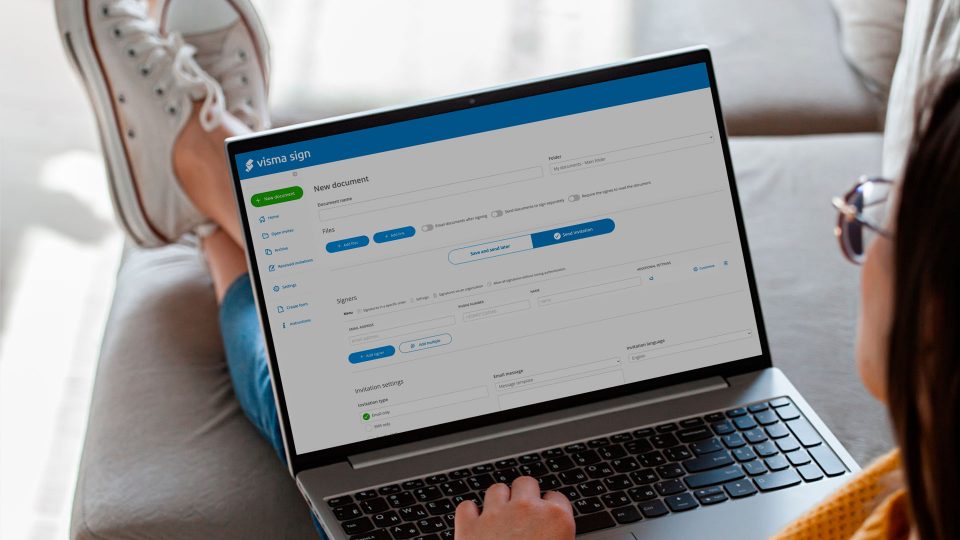
Visma Sign’s e-signature service supports both strong and simple authentication, allowing you to choose the method that best fits your signing situation. You can even mix both approaches within the same document if needed.
Both forms of electronic identification comply with EU regulation (eIDAS), which defines the three key elements of a valid electronic signature:
- The reliability of the signing method
- The immutability of the document
- The ability to verify authenticity afterwards by an independent third party
In other words, the integrity and authenticity of a digitally signed document can always be verified — making it far more reliable than its paper-based counterpart.

Terhi Tella is Senior Growth Marketing Specialist at Visma Sign. She’s inspired by content and communication that create real value, and always strives to see things from the customer’s perspective.